








About Us
If you have any problems during product use,please feel free to contact us


Scroll Down

 November 02, 2026
For pharmaceutical companies sourcing injectable glass packaging, regulatory documentation is part of the purchasing decision. QA teams need evidence of consistent quality. Regulatory affairs teams need information relevant to the intended submission. Procurement teams need a supplier whose product specifications and documentation match the project.
USP and European Pharmacopoeia requirements, ISO 15378 certification and FDA Type III DMF support address different parts of that evaluation. Understanding their roles helps buyers request the right evidence when selecting glass vials, ampoules, cartridges or prefillable glass syringes.
LINUO’s website describes pharmacopoeial testing, a CNAS-accredited laboratory and pharmaceutical packaging documentation support. The practical task is to connect these capabilities to the selected container, manufacturing site and target market.
A pharmaceutical glass supplier may reference several standards and regulatory documents. Buyers should assess them according to their purpose.
| Reference | What it addresses | Buyer’s main question |
| USP glass-container requirements | Applicable pharmaceutical glass quality requirements and testing | Does the selected container meet the agreed USP requirements? |
| European Pharmacopoeia, or Ph. Eur./EP | Requirements for glass containers for pharmaceutical use | What evidence supports the applicable EP requirements? |
| ISO 15378 | Quality management for medicinal primary packaging, incorporating GMP requirements | Does the certificate cover the proposed site and activities? |
| FDA Type III DMF | Packaging-material information that may be referenced in a drug application | Does the file cover the proposed product, and can reference be authorized? |
USP addresses pharmaceutical glass in General Chapter 〈660〉, while the European Pharmacopoeia addresses glass containers for pharmaceutical use in Chapter 3.2.1. ISO 15378 concerns quality management, and FDA identifies Type III DMFs as packaging-material files. These references provide different evidence and should be reviewed separately.

Start with the Glass Classification
Glass classification is a starting point for injectable packaging selection. USP describes borosilicate glass as Type I glass, with high hydrolytic resistance arising from its composition. It also distinguishes Type II and Type III glass.
When sourcing Type I borosilicate glass packaging, request the material description and classification for the exact product under consideration. A company’s general material capability should be linked to the container specification used for purchasing and qualification.
For example, a vial inquiry should identify the product code, capacity, drawing, glass classification and supplied condition. This gives the supplier a clear basis for identifying the applicable testing and documentation.
Connect Compliance Statements to Test Evidence
A statement such as “USP and EP compliant” is useful for initial supplier screening. During technical review, buyers need to understand what that statement means for the selected product.
Ask for a specification that identifies:
This makes supplier comparison more meaningful. Instead of comparing broad compliance claims, QA teams can compare the evidence against a common purchasing specification.
Confirm the Applicable Edition
Pharmacopoeial requirements can change. USP and EDQM have published proposed revisions concerning pharmaceutical glass evaluation, so a consultation document should not automatically be treated as an effective requirement.
The agreed specification should identify the applicable requirements and editions, with the buyer’s regulatory team assessing their relevance to the target market and submission.
ISO 15378: Assessing the Supplier’s Quality Management System
ISO 15378 specifies quality management requirements for primary packaging materials for medicinal products, incorporating GMP requirements alongside ISO 9001. It addresses the organization’s ability to consistently provide packaging that meets customer and applicable regulatory requirements.
For buyers, the certificate review should focus on four points:
| Certificate detail | What to check |
| Certified organization | Legal entity supplying the product |
| Manufacturing site | Address relevant to the proposed supply |
| Scope | Activities and packaging materials covered |
| Validity | Issue date, expiry date and certification body |
ISO 15378 certification and pharmacopoeial test reports serve complementary purposes. The certificate provides evidence concerning the quality management system; product documents provide evidence concerning the selected container.
LINUO’s references ISO 15378 support. Buyers can request the applicable certificate as part of the project’s supplier qualification package
What Is a Packaging Drug Master File?
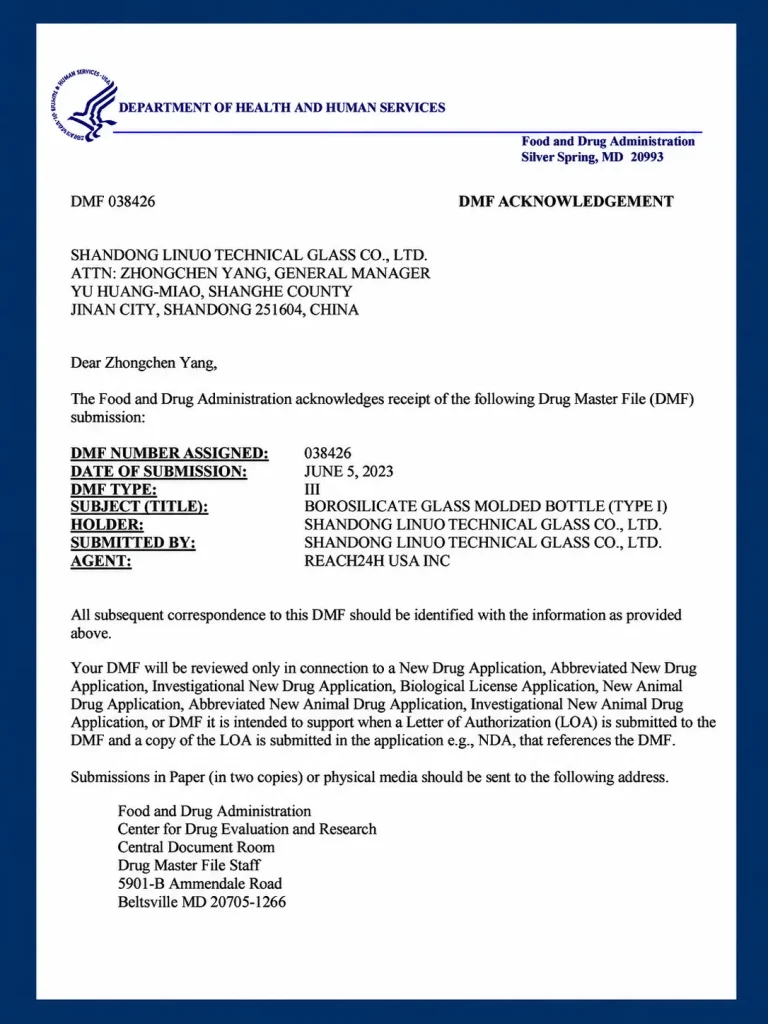
A Drug Master File allows a holder to submit confidential information to FDA. For packaging materials, a Type III DMF can provide a route for an applicant to reference proprietary supplier information through authorization from the holder.
FDA also explains that packaging information does not have to be submitted through a DMF. Where the information is available to the applicant, it may be included directly in the application.
For pharmaceutical glass buyers, the relevant question is how the supplier’s documentation supports the intended application.
Does an FDA DMF Mean the Glass Packaging Is FDA Approved?
No. A DMF is not an FDA product approval. FDA does not approve or disapprove DMFs; it reviews their technical information in connection with an application that references them. An acknowledgement letter or assigned DMF number should therefore not be presented as approval of a glass container.
This distinction helps buyers assess supplier claims accurately and use appropriate wording in internal qualification records.
Check Product Coverage Before Relying on a DMF
A supplier’s DMF information should be matched to the proposed product. Do not assume that a file associated with one packaging category covers every glass container the company supplies.
LINUO’s certifications and regulatory information includes FDA DMF-related documentation. For a specific project, request confirmation of the applicable file and its product coverage. linuo-pharma.com
A focused DMF review should establish:
Understand the Letter of Authorization
A Letter of Authorization, commonly called an LOA, permits reference to information in the holder’s DMF. FDA describes this authorization as part of incorporating DMF information by reference.
The LOA should correspond to the applicable DMF, authorized applicant and specific product information being referenced. Buyers should not assume that an LOA issued for one product family or configuration authorizes reference to another LINUO packaging product. The applicant should also confirm that the referenced DMF information is current and relevant to the proposed submission.
A useful pharmaceutical packaging qualification package connects the product specification, quality evidence and regulatory information.
The following checklist can help QA, RA and procurement teams prepare a coordinated request. It is a suggested review framework; the final document package should be agreed for the project.
| Review area | Suggested documents or information |
| Product definition | Product code, drawing, capacity and specification revision |
| Material | Glass classification and material information |
| Pharmacopoeial requirements | Applicable references and relevant testing evidence |
| Quality management | Current certificates with site and scope |
| Batch release | Certificate of analysis or agreed release documents |
| Traceability | Batch identification and supporting record arrangements |
| FDA DMF, where relevant | Product coverage and authorization information |
| RTU presentation, where applicable | Agreed processing, packaging and release documentation |
This structure also helps procurement identify documentation requirements before samples or commercial orders are arranged.
LINUO’s Testing and Documentation Support
LINUO’s CNAS-accredited pharmaceutical glass testing laboratory lists capabilities in material and chemical analysis, physical and mechanical testing, and dimensional and appearance measurement. Buyers can use these capabilities as a basis for discussing the testing evidence required for a selected container. linuo-pharma.com
LINUO describes technical and quality document support, supplier qualification assistance and audit cooperation for qualified projects. Available documents may include specifications, certificates of analysis, compliance statements and inspection or testing records, depending on the product and project. linuo-pharma.com
For an effective review, identify the documents needed for each decision. QA may prioritize testing and release criteria, RA may prioritize submission-related information, and procurement may coordinate the approved specification and supply requirements.

A clear inquiry helps the supplier respond with information relevant to the project. Include:
| Information to provide | Example of the detail needed |
| Packaging format | Vial, ampoule, cartridge or prefillable glass syringe |
| Product specification | Capacity, drawing, glass classification and finish |
| Supplied condition | Standard or RTU presentation |
| Target market | Countries or regions relevant to the project |
| Documentation needs | Pharmacopoeial evidence, quality certificates or DMF support |
| Project stage | Initial evaluation, qualification or commercial sourcing |
| Purchasing requirements | Sample quantity, estimated volume and required timeline |
Contact LINUO to discuss the proposed container and the documentation available for your supplier qualification process.
What is the difference between USP compliance and FDA DMF support?
USP compliance concerns applicable pharmaceutical quality requirements and testing. FDA DMF support concerns information that may be referenced in a drug application. They address different parts of the packaging evaluation.
Is a Type III DMF required for pharmaceutical glass packaging?
FDA does not require packaging information to be submitted through a DMF. Information may be included directly in the application, while a Type III DMF provides a route for referencing proprietary supplier information. www.fda.gov
Does ISO 15378 certification prove that a specific vial meets USP requirements?
The certificate addresses the quality management system within its stated scope. Buyers should review the vial’s specification and relevant testing evidence separately.
Can one FDA DMF cover vials, cartridges and syringes?
LINUO uses product-specific FDA DMF references for different pharmaceutical glass packaging categories. Buyers should confirm the applicable DMF number against the exact product family, specification, manufacturing site and supplied configuration. A DMF associated with a vial, cartridge, ampoule, prefillable syringe or RTU product should not be assumed to cover another product category.
What information should I send LINUO for a regulatory documentation inquiry?
Provide the container type, specification or drawing, target market, supplied condition and required documents. If DMF reference support is needed, state that requirement at the beginning of the inquiry.

We will reply to you within 24 hours. If for urgent case, please add WhatsApp/WeChat: +8615953131507, Or call +8618615646416 directly.
*We respect your confidentiality and all information are protected.
We will only use your information to respond to your inquiry and will never send unsolicited emails or promotional messages.