








Sobre nosotros
Si tiene algún problema durante el uso del producto, no dude en ponerse en contacto con nosotros



Desplácese hacia abajo

 7 de agosto de 2026
 Viales de vidrio RTU arrive washed, depyrogenated, packaged and terminally sterilized, so your fill-finish line drops washing and depyrogenation tunnel steps. Nest-and-tub is built for robotic handling of small, high-value batches; tray formats handle larger volumes differently. Sterilization method and documentation drive qualification effort more than vial geometry does.
A bulk vial purchase is a glass purchase. An RTU vial purchase is a glass purchase plus a processing step you have transferred to your supplier, plus a sterility claim you now have to defend in your own file.
That transfer is the whole point, and it is also where most qualification surprises come from. The washing, depyrogenation, nesting and terminal sterilization all happen inside the supplier’s facility, under the supplier’s validated cycle. Your process validation no longer covers those steps. Your supplier qualification does. Teams that budget for the container change and not the documentation change are the ones that end up six weeks behind.
The physical change on the line is easier to predict. Washing machines, the depyrogenation tunnel and the accumulation table upstream of the filling needles go quiet. Downstream stays roughly the same. What replaces the upstream equipment is a tub-opening and denesting step, and that is where the nest-and-tub versus tray decision starts to matter.
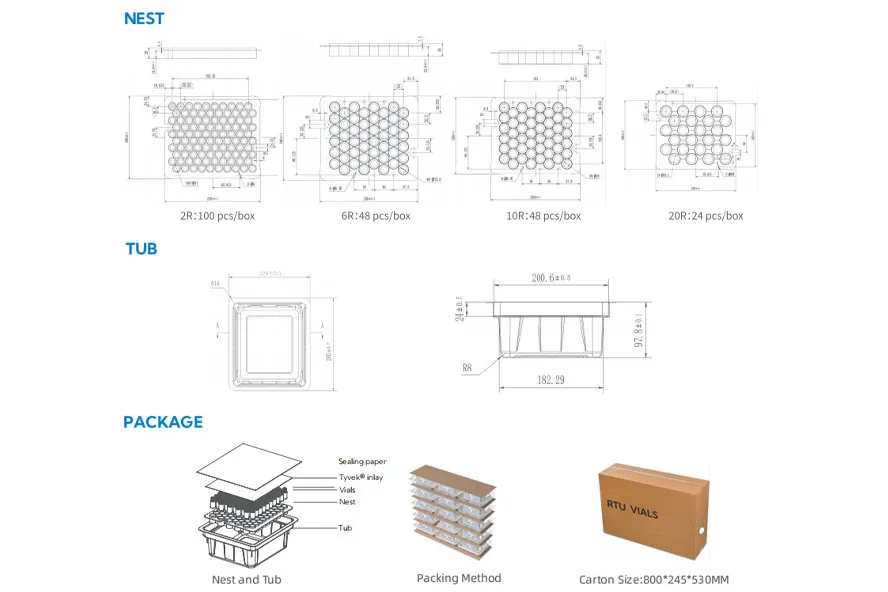
The comparison below is format-level, not brand-level. Individual suppliers configure nests, tubs and trays differently, so confirm each row against the technical data sheet for the specific product you are qualifying.
| Dimensión | Nest and Tub | Tray Packaging |
|---|---|---|
| Handling unit | Vials held in a fixed-pitch nest inside a sealed tub | Vials held in a tray, typically with a larger count per unit |
| Line interface | Designed for robotic pick-and-place and no-contact transfer | Suited to transfer systems already built around tray handling |
| Vial-to-vial contact | Nest pitch keeps vials separated during transport and filling | Depends on tray geometry; confirm vial contact and cosmetic defect risks |
| Denesting | Nest removal step required; nest geometry must match the filling equipment | Tray removal step required, with different gripper and infeed requirements |
| Format changeover | Change parts are determined by nest geometry and vial size | Change parts are determined by tray layout |
| Storage volume per vial | Higher, because the tub and nest occupy additional space around each vial | Generally more compact per vial than tub-based formats |
| Best fit | Small-batch, high-value, aseptic robotic filling | High-volume filling where the production line is already tray-configured |
| Secondary waste | Tub, nest, and Tyvek lid for each packaging unit | Tray and outer packaging for each unit |
Two rows in that table decide most projects. The first is line interface: if your filling machine was specified around a particular nest footprint, a tray format is not a drop-in substitute and vice versa. The second is storage volume. A tub occupies far more warehouse space per vial than a bulk carton, and cold-chain or controlled-environment storage makes that difference expensive rather than merely inconvenient.
Compared with the branded RTU platforms that dominate this category, where each vendor documents its own format against its own specification, a format-neutral evaluation means you have to do the compatibility work yourself. There is no cross-platform equivalence table you can rely on. Ask for the nest drawing early.
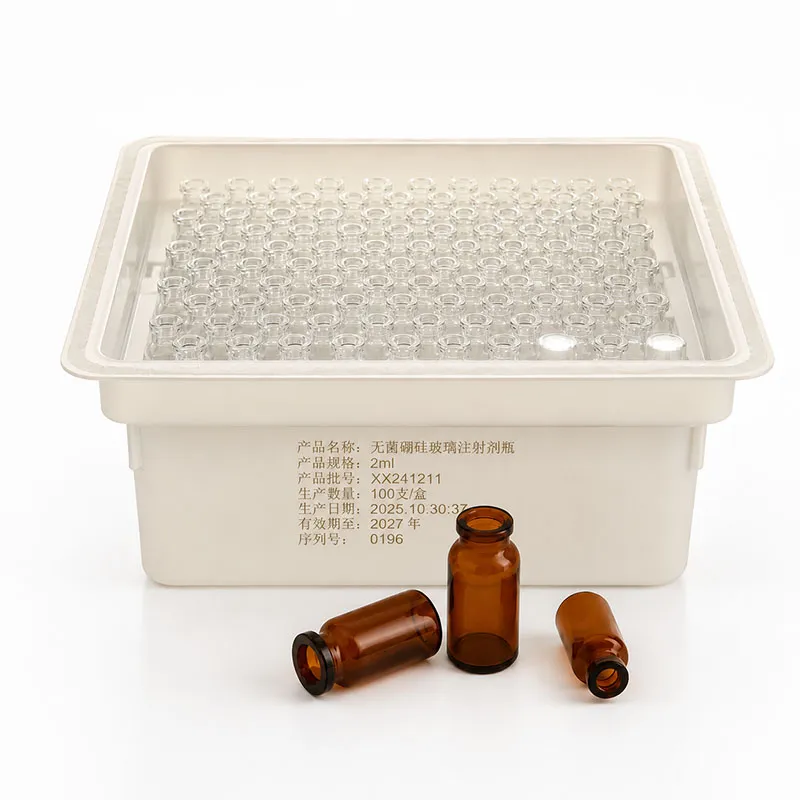
LINUO‘s published product pages state ETO as the sterilization method for its RTU vials. Ethylene oxide is not interchangeable with steam or gamma sterilization from a documentation standpoint, and a qualification plan written around one and executed against another creates rework.
Three practical consequences follow.
Residual testing becomes part of your incoming specification. Ethylene oxide and its reaction products have residual limits under the biological evaluation framework in the ISO 10993 series, and you will want the supplier’s residual data as a routine deliverable rather than a one-time sample result.
Sterility assurance level and cycle validation belong to the supplier’s file, and you need to see it. Under EU GMP Annex 1, the sterility of incoming pre-sterilized components is part of the contamination control strategy you are expected to justify, not something you can treat as a supplied given.
Packaging integrity carries the sterility claim between the supplier’s cycle and your isolator. Tub seal integrity, transport handling and the no-touch transfer method into the aseptic core all have to be assessed as one chain.
One edge case worth flagging: if you are filling a drug substance with known sensitivity to trace alkylating residues, ETO-sterilized primary packaging may need a compatibility study that a steam-sterilized container would not have triggered. Raise this at the sampling stage, not after stability has started.
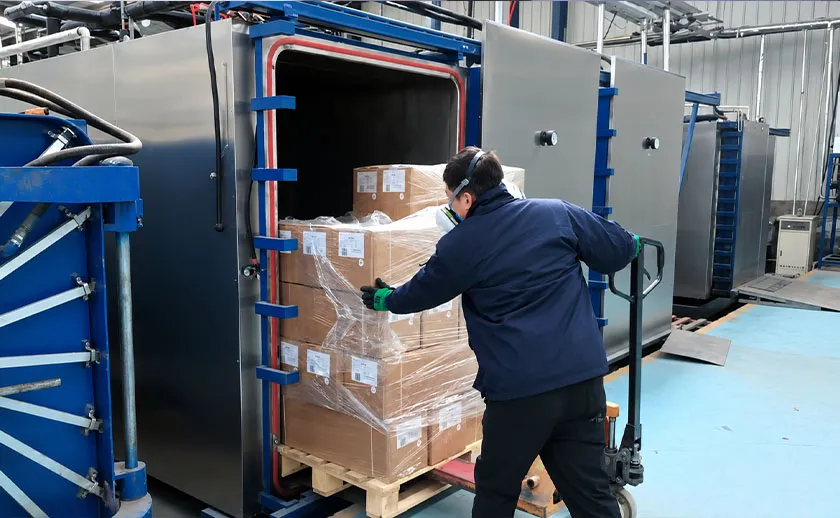
LINUO’s RTU glass vials are published across a nominal size range of 2R, 4R, 6R, 8R, 10R, 15R, 20R, 25R, 30R and 50R, in pharmaceutical borosilicate glass, supplied in nest-and-tub or tray packaging. Delivery condition is washed, depyrogenated, packaged and terminally sterilized, with ETO stated as the sterilization method on the product pages.
| Parámetro | Published Position |
|---|---|
| Nominal sizes | 2R, 4R, 6R, 8R, 10R, 15R, 20R, 25R, 30R, 50R |
| Glass | Pharmaceutical borosilicate glass |
| Packaging formats | Nest and tub; tray |
| Delivery condition | Washed, depyrogenated, packaged, and terminally sterilized |
| Método de esterilización | ETO |
| Stated applications | Biologics, vaccines, monoclonal antibodies, lyophilized drugs, cell and gene therapy products, high-value injectables, and aesthetic injectables |
| Quality system reference | ISO 9001:2015, Certificate No. CN23/00002781, issued by SGS United Kingdom Ltd.; the published scope includes sterile borosilicate glass vials |
| Published RTU vial line capacity | Approximately 70 million units per year |
Dimensional expectations for tubular injection vials sit under ISO 8362-1, and the glass itself is assessed against USP General Chapter <660> for containers made of glass. Neither standard specifies nest or tray geometry, which is exactly why the nest drawing is a separate conversation from the vial drawing.
The capacity figure above is a published production-line figure for one product line. It tells you something about scale-up headroom. It tells you nothing about lead time for your specific size and configuration, which is a quotation question.
“RTU means the container is qualified.”
It does not. RTU describes the condition in which the container arrives. Qualification is still yours: container-closure integrity with your specific stopper and cap combination, extractables and leachables against your formulation, machine compatibility on your line, and stability in your primary packaging.
The related misreading is regulatory. A supplier holding an FDA Drug Master File for one product family has not thereby registered every product family it makes. LINUO’s publicly documented DMF records illustrate the point: DMF 038426 covers a Type I borosilicate molded glass bottle, and DMF 041474 covers prefillable glass syringes. Neither is an RTU vial DMF. If a supplier’s RTU vial page implies DMF coverage, ask which DMF number, which type, and for the acknowledgement letter itself.
The advantages are straightforward: fewer processing steps in your clean area, lower particulate and endotoxin risk from washing operations you no longer run, faster changeover for small batches, and a much shorter path from clinical to commercial for high-value injectables.
The costs are equally concrete, and they are not trivial.
Unit price sits materially above bulk vials of the same size, because you are buying processing you would otherwise perform. Warehouse space per vial rises with tub-based formats, which matters most where storage is temperature-controlled. Format lock-in is real: once your line is tooled for one nest geometry, changing supplier means re-validating machine compatibility, not just re-qualifying glass. Supplier dependency increases, since a sterilization deviation at the supplier’s site becomes a supply interruption you cannot resolve internally. And for large-volume, low-value products, the economics frequently do not close at all.
Q: Is nest-and-tub better than tray packaging for lyophilized products?
A: The format itself does not determine lyophilization suitability. What matters is whether the nest or tray material and geometry are compatible with your loading system and whether vials can be transferred into the lyophilizer in the presentation your equipment expects. Some lines load nested, others require denesting first. Confirm with your lyophilizer supplier before selecting a format.
Q: Can I use one supplier’s vials in another supplier’s nest?
A: Treat this as no by default. Nest pitch, well geometry and tub dimensions are not standardized across suppliers, and ISO 8362-1 covers the vial rather than the nest. Any cross-supplier substitution requires machine compatibility testing and a documented change assessment.
Q: Does LINUO hold an FDA DMF for RTU glass vials?
A: The publicly available DMF records are DMF 038426, a Type III file covering a Type I borosilicate molded glass bottle, and DMF 041474, a Type III file covering prefillable glass syringes. No separate product-specific DMF acknowledgement for RTU glass vials was identified in the public download centre. If DMF coverage is a requirement for your submission, raise it directly with the supplier and ask for the acknowledgement letter.
Q: Is the ISO 15378 certificate current?
A: The publicly downloadable ISO 15378:2017 certificate, number CN16/10384 from SGS Hong Kong Limited, carries a stated validity end date of March 2, 2025. Request the renewed certificate directly and check its issue date rather than treating the posted file as current.
Q: What sizes are available, and can they be customized?
A: Published nominal sizes run from 2R to 50R across ten formats. Configuration variables including packaging format, surface treatment and coding are handled through quotation. Dimensional customization outside the published range needs technical confirmation before you assume feasibility.
Q: How is sterility maintained between the supplier’s site and my isolator?
A: Through the tub seal and the no-touch transfer method into the aseptic core. This chain is part of your contamination control strategy under EU GMP Annex 1, so the transport handling, seal integrity data and transfer validation belong in your file, not only the supplier’s.
Q: What is the minimum order quantity?
A: Not published. MOQ varies by size, format and configuration and is set at quotation. Ask for it in the same request as the technical data sheet so that format selection and commercial feasibility are assessed together.
Q: Do I still need extractables and leachables studies if the vials are pre-sterilized?
A: Yes. Pre-sterilization does not substitute for compatibility assessment with your formulation. If anything, ETO-sterilized packaging adds residual considerations under the ISO 10993 series on top of the standard glass extractables profile.
Te responderemos en un plazo de 24 horas. Si se trata de un caso urgente, añadenos en WhatsApp o WeChat: +8615953131507, o llama directamente al +8618615646416.
*Respetamos su confidencialidad y toda la información está protegida.
Solo utilizaremos su información para responder a su consulta y nunca enviaremos correos electrónicos no solicitados ni mensajes promocionales.