








Onderscheidingen
Als u problemen ondervindt tijdens het gebruik van het product, kunt u gerust contact met ons opnemen

Scroll omlaag

 October 16, 2026
For emerging biopharmaceutical innovators, university spin-outs, and specialty contract development and manufacturing organizations (CDMOs), early-phase drug development is a race against capital burn and strict regulatory milestones. Whether preparing an Investigational New Drug (IND) filing or compounding investigational medicinal products (IMPs) for Phase I/II clinical trials, clinical supply chain teams face a persistent procurement roadblock: primary packaging supply chains engineered almost exclusively for multi-million-unit commercial campaigns.
When clinical formulations require only 2,000 to 20,000 units, traditional packaging manufacturers impose prohibitive Minimum Order Quantities (MOQs) of 100,000 to 500,000 units, alongside lead times exceeding six to nine months. Concurrently, installing and validating in-house washing, depyrogenation, and sterilization equipment is financially and technically unfeasible for early-stage development.
This technical guide examines how Ready-to-Use (RTU) pre-sterilized glass containers overcome the clinical procurement bottleneck. We outline the operational advantages of pre-sterilized components, explain the verified packaging configurations available for vials and cartridges (including factory-calibrated nest and tray pack densities), and present an agile sourcing framework with an accessible clinical MOQ of 2,000 units and responsive lead times.
During preclinical characterization and early clinical phases, project requirements are fundamentally misaligned with legacy glass manufacturing models:
| Clinical Demand Reality | Commercial Packaging Barriers |
| Batch sizes: 2,000–20,000 units | Commercial MOQs: 100,000–500,000 units |
| Rapid trial timelines (IND) | Lead times: 24–36 weeks |
| Iterative formulation shifts | Rigid scheduling windows |
| Lean capital management | High cost of excess inventory |
Traditional glass manufacturers set order thresholds based on continuous furnace and converting line economics. For clinical-stage programs, this model creates severe operational liabilities:
Faced with high commercial MOQs, some clinical teams evaluate sourcing bulk non-sterile glass and performing washing, depyrogenation, and sterilization internally. However, primary container preparation for sterile injectables requires extensive qualification:
For agile clinical programs, dedicating engineering bandwidth to qualify glass washing machines diverts critical resources away from formulation stability, bioassays, and clinical site activation.
Ready-to-Use (RTU) packaging fundamentally restructures this operational equation. Supplied washed, depyrogenated, and terminally pre-sterilized, RTU formats eliminate component preparation bottlenecks while preserving full cGMP traceability.
Fill-Finish Process Comparison:
Traditional Bulk Glass Workflow:
[Bulk Receiving] ➔ [Automated Washing] ➔ [Depyrogenation Tunnel] ➔ [Aseptic Core Entry] ➔ [Fill-Finish]
Pre-Sterilized RTU Workflow:
[RTU Packaging Receipt] ➔ [Validated Outer De-Bagging] ➔ [De-Lidding / Core Entry] ➔ [Direct Aseptic Filling]
└────── Eliminates On-Site Cleaning & Tunnel Validation ──────┘
By partnering with an agile low moq sterile vials supplier, clinical sponsors receive containers that have completed industrial-grade cleaning and terminal sterilization:
In small-scale clinical fill-finish suites—ranging from flexible robotic isolators to glovebox lines (e.g., Cytiva Vanrx, Bausch+Ströbel, Groninger)—nested RTU configurations ensure zero glass-to-glass contact. This mechanical isolation eliminates surface micro-scratches, preserves glass mechanical strength, and minimizes particulate shedding inside ISO 5 critical zones.
Evaluating Packaging for an Upcoming Clinical Trial Campaign?
Access standardized dimensional drawings (2R–50R vials & 1.5ml–3ml cartridges), packaging configuration schematics, and batch release specifications to verify filling line and device compatibility.
[ Inquire About Clinical Batch Availability & Standard Spec Sheets ]
(Tier 2: Work Email + Target Container Format)
To support rapid line integration and eliminate tooling delays for clinical fill-finish facilities—ranging from automated robotic nested isolators to manual bulk de-nesting benches and freeze-dryers—Linuo supplies standardized container formats with verified factory pack quantities.
Official RTU Specification & Packaging Matrix:
| Category | Specification / Format | RTU Vials – Nest & Tub | RTU Vials – Tray | Clinical Process & Engineering Notes |
| RTU Vials | 2R | 100 pcs / box | 228 pcs / tray | High-potency APIs, small peptides, cell/gene therapy |
| RTU Vials | 4R | 100 pcs / box | 228 pcs / tray | Low-volume biologics, pediatric formulations |
| RTU Vials | 5mL | 48 pcs / box | — (Not offered in Tray) | Biologic liquid injectables (Nest & Tub only) |
| RTU Vials | 6R | 48 pcs / box | 96 pcs / tray | Primary workhorse for mAbs, vaccines, and lyophilization |
| RTU Vials | 8R | 48 pcs / box | 96 pcs / tray | Lyophilized cakes, larger reconstitution volumes |
| RTU Vials | 10ml (φ22) | Campaign scheduling | Campaign scheduling | Slender 22mm outer diameter format (available on request) |
| RTU Vials | 10R (φ24) | 48 pcs / box | 96 pcs / tray | Standard 24mm outer diameter (ISO 8362-1) format |
| RTU Vials | 20R | 24 pcs / box | 60 pcs / tray | High-volume infusions, IV reconstitution sets |
| RTU Vials | 30R | 24 pcs / box | 60 pcs / tray | Multi-dose therapeutic biologics |
| RTU Vials | 50R | 16 pcs / box | 28 pcs / tray | Large-volume parenteral solutions, hospital admixtures |
| RTU Cartridges | 1.5 ml | 100 pcs / box | — (Nest & Tub only) | Ophthalmic micro-dosing, specialized dental delivery |
| RTU Cartridges | 1.8 ml | 100 pcs / box | — (Nest & Tub only) | Standard dental local anesthetics (Carpules) |
| RTU Cartridges | 3.0 ml | 100 pcs / box (Box: 260×226mm) | — (Nest & Tub only) | GLP-1 analogues, insulin pens, autoinjector platforms |
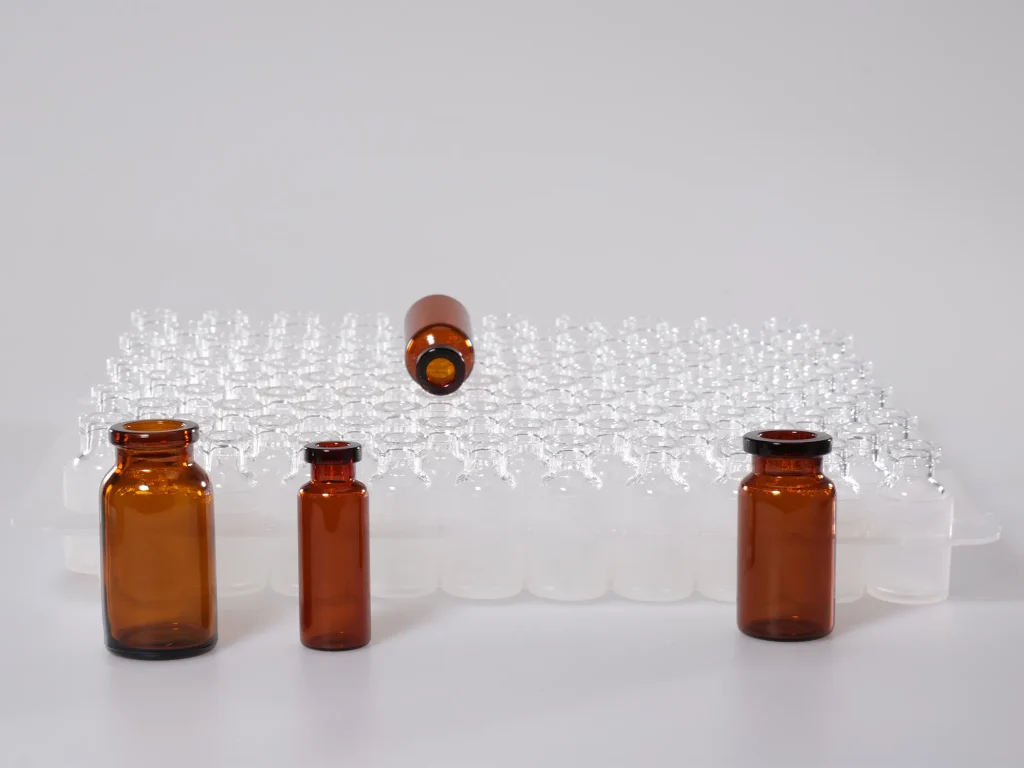
1. RTU Tubular Glass Vials: Nest & Tub vs. Tray Packaging
Available in Type I borosilicate glass (clear or amber), Linuo provides two distinct packaging configurations to accommodate varying clinical fill-finish architectures:
For targeted peptide therapeutics, GLP-1 analogues, and self-administration delivery systems, clinical development teams frequently evaluate pilot batch sterile glass cartridges:
Note on Closures: Standard elastomer components (13mm and 20mm bromobutyl stoppers) and flip-off aluminum seals (available in standard 100-piece and 1,500-piece bags) can be aligned alongside container orders. Please note capping equipment specifications (rotary capping vs. claw crimping) to match appropriate cap skirt heights.
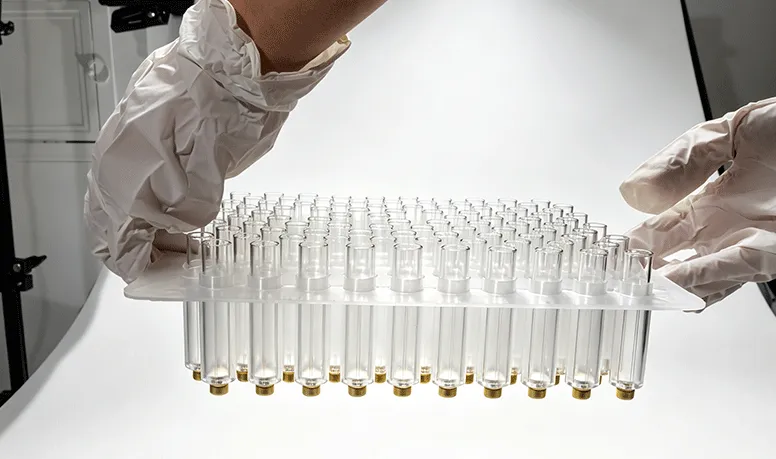
For clinical sponsors, container qualification is a core regulatory requirement. Investigational drug submissions under US FDA Investigational New Drug (IND) applications, European Clinical Trial Applications (CTAs), or Health Canada frameworks require verified Module 3 CMC (Chemistry, Manufacturing, and Controls) container closure data.
To ensure seamless regulatory acceptance, Linuo supports clinical sponsors with a complete quality dossier:
| Quality / Regulatory Document | Function in Clinical Filing | Supporting Data Provided by Linuo |
| Batch Certificate of Analysis (CoA) | Confirms component quality for clinical lot release | Complete lot-specific data covering dimensional compliance, hydrolytic resistance, sub-visible particulate counts, and bacterial endotoxin testing. |
| Compendial Compliance Summary (TDS) | Substantiates Module 3 container characterization | Testing data proving compliance with USP <660> Type I, Ph. Eur. 3.2.1, and relevant ISO standards. |
| US FDA Type III DMF Authorization (LOA) | Enables confidential agency review of packaging manufacturing data | Linuo holds active US FDA Type III DMF #040947. Sponsors are issued formal Letters of Authorization (LOA) referencing technical container data. |
| 2-Year Sterile Shelf-Life Validation | Verifies sterile barrier integrity during storage | Validated Ethylene Oxide (EtO) terminal sterilization conforming to ISO 11135 principles, supporting a verified 2-year sterile shelf life. |
Important Regulatory Boundary: While pre-sterilized RTU containers eliminate the need for on-site washing and depyrogenation validation, the drug sponsor remains responsible for verifying container-closure integrity (CCI) of the final assembled system (vial/cartridge + stopper + seal + formulation) and establishing drug-container chemical compatibility across product stability programs.
Sourcing rtu vials clinical phase 1 2 3 batches requires an efficient, milestone-based process that balances engineering diligence with delivery speed:
Structured 4-Stage Clinical Sourcing Roadmap:
Stage 1: Specification Review ➔ Stage 2: Quality & Regulatory ➔ Stage 3: Flexible Allocation ➔ Stage 4: Validated Logistics
1.Stage 1: Specification & Packaging Alignment
The sponsor’s packaging engineer verifies outer dimensions, neck finishes (13mm or 20mm), and packaging formats (Nest & Tub vs. Tray with neck up/down) against the target filling line or CDMO equipment.
2.Stage 2: Quality Documentation & Regulatory Authorization
The sponsor’s QA and Regulatory teams review representative Batch CoA templates and request a formal Letter of Authorization (LOA) for US FDA Type III DMF #040947 to support their IND/CTA dossier. (To explore how primary packaging quality is governed across commercial lifecycles, see our overview of ISO 15378 Quality Systems and Traceability).
3.Stage 3: Responsive Allocation and Campaign Scheduling
4.Stage 4: Protective Transit and Clinical Site Handover
Double-bagged, nested or tray-packed containers are secured in heavy-duty export shippers. Products are dispatched under traceable logistics, complete with lot release certificates and a verified 2-year sterile shelf life, ready for immediate receipt and cleanroom transfer.
Before finalizing primary packaging selection for an upcoming clinical trial, supply chain and development teams should review this 5-point engineering checklist:
Packaging Format Match: Does the CDMO or internal filling line require Nest & Tub automated handling, or does freeze-dryer loading favor Tray packaging (neck-up or neck-down)?
Capping Interface Verification: Has the capping machine mechanism (rotary continuous capping vs. claw crimping) been verified against the selected aluminum seal skirt height?
Regulatory Master File Status: Is an active US FDA Type III DMF available with an established LOA issuance process?
Sterile Integrity & Expiry: Does the container’s validated sterile shelf life (2 years) comfortably cover the planned stability study and clinical dosing window?
Evaluation Sample Protocol: Have engineering line-trial samples been scheduled for machinability testing? (Note: Standard line-trial evaluation samples are provided on a fee-based basis to ensure dedicated engineering review and lot traceability).
Navigating early-phase drug development requires packaging partners who combine small-batch agility with commercial-grade quality rigor. At Linuo, our dedicated RTU production facility bridges this gap—supporting innovative biotechs and specialty CDMOs worldwide with:
Protect your clinical timelines with pre-sterilized RTU packaging backed by comprehensive regulatory documentation. Contact our technical team today to discuss format selection, request engineering drawings, or receive a fast-track quotation for your upcoming clinical batch.
We nemen binnen 24 uur contact met u op. In dringende gevallen kunt u ons toevoegen op WhatsApp/WeChat: +8615953131507, of direct bellen naar +8618615646416.
*We respecteren uw vertrouwelijkheid en beschermen al uw gegevens.
We zullen uw gegevens uitsluitend gebruiken om op uw vraag te reageren en zullen nooit ongevraagde e-mails of promotionele berichten sturen.