







Sobre nosotros
Si tiene algún problema durante el uso del producto, no dude en ponerse en contacto con nosotros


Desplácese hacia abajo

 July 03, 2026
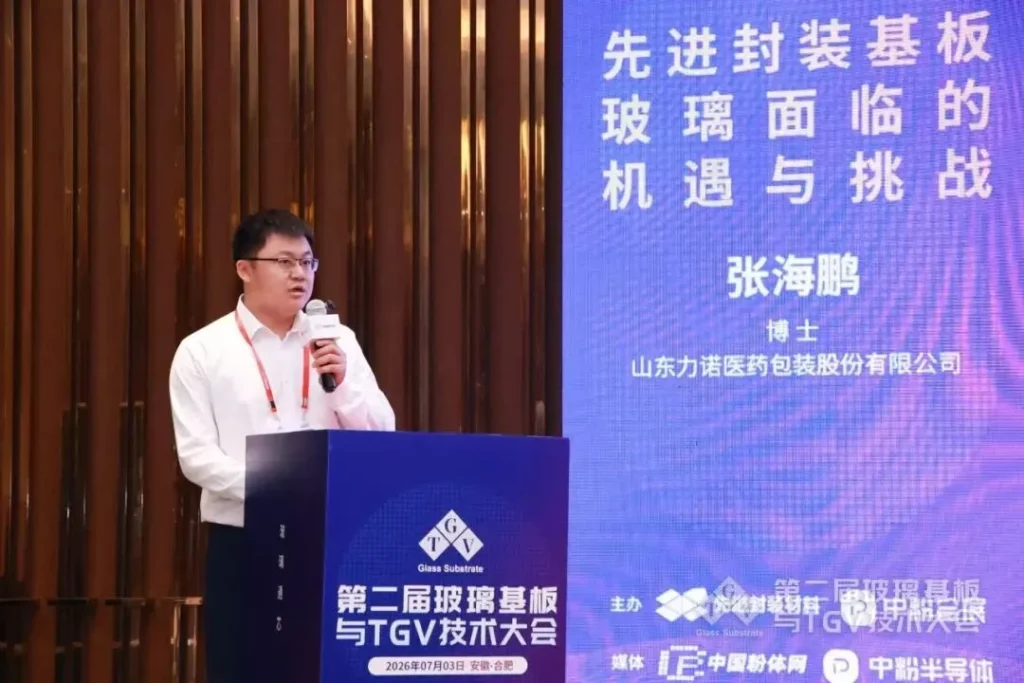
 On July 3, the 2nd Glass Substrate and TGV Technology Conference was officially held in Hefei, Anhui Province, China. Focusing on three key themes — TGV (Through Glass Via) technology advancement, the application of glass substrates in AI and high-performance computing, and innovation in materials and manufacturing processes — the conference brought together experts from industry, academia, research institutions, and application sectors to explore future development pathways for the industry in the post-Moore’s Law era.
Dr. Zhang Haipeng, from the Industrial Incubation Center of Linuo Pharmaceutical Packaging, delivered a keynote speech at the conference, systematically sharing Linuo’s technological achievements, accumulated expertise, and integrated solutions in the field of glass substrates.
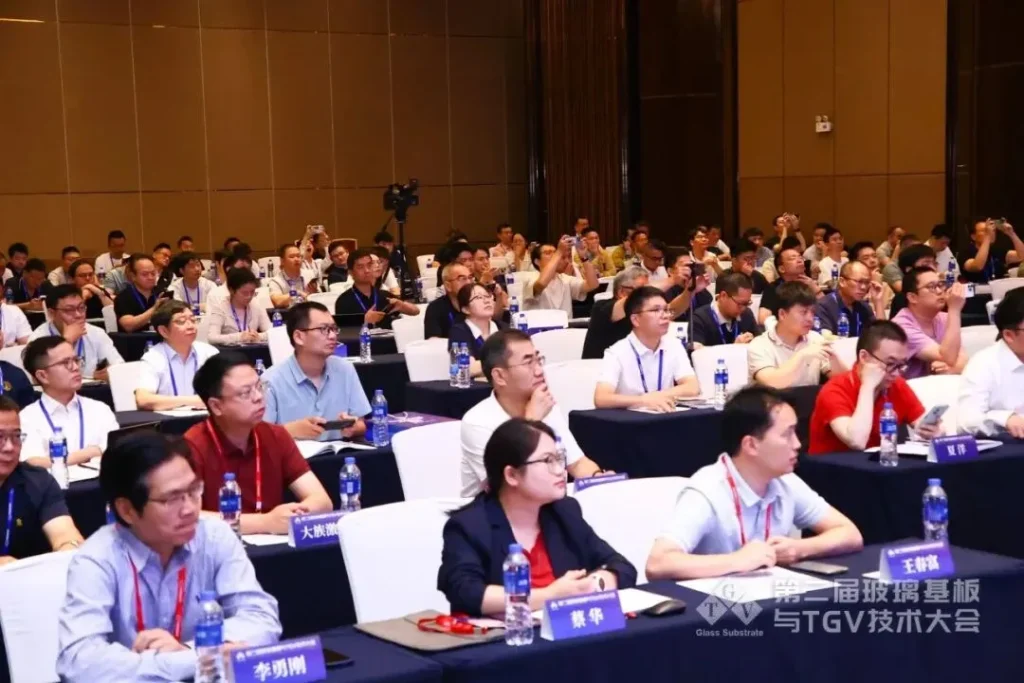
As semiconductor processes approach physical limits, the growth momentum of the semiconductor industry is shifting toward system-level packaging. The rapid development of AI and high-performance computing has placed higher demands on packaging materials in terms of dimensional stability, electrical performance, and scalability.
Traditional substrates are facing bottlenecks in areas such as large-scale dimensional flatness, cost efficiency, and interconnection density. In contrast, glass substrates have emerged as a key material platform for the post-Moore’s Law era, thanks to their advantages including adjustable composition, ultra-high flatness, precise CTE (Coefficient of Thermal Expansion) matching, low dielectric loss, and high rigidity with excellent warpage resistance.
In advanced packaging applications, glass can serve as a substrate, interposer, or glass bridge, enabling high-density interconnects and optoelectronic co-packaging. It can also function as a temporary process carrier, supporting wafer thinning and precision manufacturing processes.
At this conference, industry experts engaged in in-depth discussions on key technologies such as laser drilling and electroplated via filling, reflecting the industry’s accelerating efforts toward the commercialization of glass substrate technologies.
Dr. Zhang Haipeng explained that the large-scale application of glass substrates still faces challenges including brittleness, melting defects, forming precision, and residual stress control.
Leveraging more than 30 years of experience in the research, development, and manufacturing of specialty glass, Linuo Pharmaceutical Packaging has established a systematic technology roadmap covering four key dimensions: material formulation design, melting processes, forming technologies, and annealing control, addressing these industrial challenges one by one.
The company currently operates 16 specialty glass furnaces, 52 production lines, and comprehensive downstream processing capabilities. Supported by a CNAS-accredited laboratory, provincial-level technology center, and postdoctoral research workstation, Linuo has successfully achieved a technological transition from pharmaceutical glass and heat-resistant glass to advanced glass substrates, establishing a solid industrial foundation for future development.
With the continued growth of AI computing demand, glass substrates are evolving from a supporting process material into a core component of advanced packaging architectures. In the short term, glass substrates are expected to achieve large-scale adoption in areas such as temporary wafer carriers and RF modules. In the medium to long term, their applications will gradually expand into high-end high-performance computing and large-scale panel-level packaging, significantly broadening market opportunities.
Linuo Pharmaceutical Packaging will continue to focus on innovation in specialty glass materials, accelerating pilot validation and commercialization of glass substrate technologies. Upholding an open and collaborative approach, the company will deepen cooperation with partners across the industrial chain, including equipment manufacturers, packaging companies, and end-device enterprises, to jointly advance the maturity and widespread adoption of glass substrate technologies.
Through these efforts, Linuo aims to contribute to the self-reliance, controllability, and high-quality development of advanced semiconductor packaging materials in China, supporting the next generation of semiconductor innovation.
Produced by | Brand Center
Written & Edited by | Qi Jinlong
Image Source | Official Conference Materials
Responsible Editor | Mei Jinjiao
The conference focused on the advancement of TGV technology, the application of glass substrates in AI and high-performance computing, and innovation in materials and manufacturing processes for advanced semiconductor packaging.
Glass substrates offer advantages such as ultra-high flatness, adjustable composition, precise coefficient of thermal expansion matching, low dielectric loss, high rigidity, and strong warpage resistance, making them suitable for high-density interconnects and advanced packaging applications.
TGV, or Through Glass Via, is a technology that creates vertical electrical interconnections through glass substrates. It can support high-density interconnection structures used in advanced semiconductor packaging and related applications.
LINUO focuses on challenges including glass brittleness, melting defects, forming precision, and residual stress control. Its technology roadmap covers material formulation design, melting processes, forming technologies, and annealing control.
According to the article, LINUO operates 16 specialty glass furnaces and 52 production lines, supported by downstream processing capabilities, a CNAS-accredited laboratory, a provincial-level technology center, and a postdoctoral research workstation.
LINUO plans to accelerate pilot validation and commercialization of glass substrate technologies while strengthening cooperation with equipment manufacturers, packaging companies, and end-device enterprises across the semiconductor industry chain.
Le responderemos en un plazo de 24 horas. Si se trata de un caso urgente, añada WhatsApp/WeChat: +8618615646416 o llame directamente al +8618615646416.
*Respetamos su confidencialidad y toda la información está protegida.
Solo utilizaremos su información para responder a su consulta y nunca enviaremos correos electrónicos no solicitados ni mensajes promocionales.